I know next to nothing about China. I have been mostly uninformed on their culture, values, governance, and history. I don’t think this is very uncommon in the United States; I don’t know anyone that isn’t Chinese that knows much about China. This is despite China being the second largest superpower, and most dominant force in many industries like textiles, steel, solar panels, EVs, Rare Earth Minerals, and consumer electronics. And now China has come after an industry close to me, technology and specifically AI. China is marshaling the full force of their entire nation to dominate AI.
- What’s this Analysis
- Why does China care about AI?
- How far behind is China and what are they doing?
- Conclusion
What’s this Analysis
As a software engineer, I have developed a love of “systems thinking” or understanding things fundamentally and developing intuition of how interactions work. In that vein, I took this as an opportunity to develop a systems understanding of China and AI, going beyond headlines to examine cultural, technical, and geopolitical motivations driving the country. This analysis considers China’s current situation and it’s plans to dominate AI, focusing on understanding of the greater battlefield over a specific conflict. While there are details I am omitting, and this topic can easily fill a book, the goal is to grap the systems at play to help make sense of this war’s past, present, and predict it’s future.
Why does China care about AI?
It’s important to understand why China cares about AI. Most analyses dive into what China is doing about AI but they don’t understand why, this cripples the full systems understanding of what is happening. It’s like a doctor prescribing medicines only reading WebMD and never understanding the chemical compounds and biological interactions that occur. If you understand the whys and the hows, then you can start to understand and predict the future; you can predict how China would react to a policy, or change course from new developments.
Century of Humiliation
This is likely the most motivating factor in the AI wars and yet the least amount of Americans know about it. The Century of Humiliation is a “deep seated part of the Chinese psyche.”1 This makes the threats and power of AI become vivid, it upgrades the intensity of this battle from being an economic goal to an existential one. To put it very briefly, the Century of Humiliation is commonly summarized with the following 3 4-word idioms.2
- Lü zhan lü bai (屡战屡败): “repeatedly fought and lost”
- Ge di pei kuan (割地赔款): “to cede territory and pay indemnities”
- Sang quan ru guo (丧权辱国): “to surrender sovereign rights and bring humiliation to the country”
This is a century from ~1840 to ~1940 where China fought in the First Opium War, the Second Opium War, the Sino-Japanese War, and the Japanese invasion of Manchuria.2 In each of these wars China was defeated and was forced to pay huge reparations, to open up trade, to cede territory, or to make other concessions to foreign countries.2
This series of humiliating events, along with their burning into the Chinese psyche by retellings and “patriotic education,” has made China jaded. It is untrustworthy of foreign powers, and has become determined to never be in a position of weakness to risk that the trauma will repeat. Economic development and modernization were not goals for China but crises. It has always been life or death for China to dominate and this intensity makes all other reasons to gain AI dominance that much more important.
This makes the recent American hostilities toward China and extreme rhetoric ring even louder. The U.S. is threatening and attacking China over AI, manufacturing, EVs, and solar along with Trump escalating a huge trade war with China, the government is scared. The trauma is ringing louder than ever, and is pushing China to act. China sees the writing on the wall and won’t let it repeat.
AI Alignment
China has writen a set of rules regulating and governing AI services, in these rules it states:
“Content generated through the use of generative AI shall reflect the Socialist Core Values, and may not contain: subversion of state power; overturning of the socialist system; incitement of separatism… as well as content that may upset economic order or social order.”
China is completely different from the U.S. in many ways, but morality and ethics are among chief. The enlightenment ideals of free speech, information democratization, and democracy are extremely western. The Chinese government wants control of these powerful AI models in the same way that they control information, press, media, social media, and more. This censorship follows in line with the Confucianist values of Harmony (Ren) and Ritual / Proper Conduct (Li), to prevent disorder, maintain moral unity and moderate speech China employs these tactics. To achieve these moral values AI must be in China’s direct control, outsourcing is not possible.
AI training embeds bias
AIs are fundamentally tools, but unlike hammers and rulers they are inherently biased. Based on how they are trained, what data they are given, and how they are instructed to act, they will embed those biases into every word they output. One key example is RLHF or Reinforcement Learning with Human Feedback. RLHF is a step in the training process where humans rank or score how good an AI’s response is, there is a core understanding built in on what is correct, true, moral, right, etc. In every step of training an AI model you fundamentally embed biases, morality, culture, etc. It is not possible to just tell an American model to act Chinese, these biases are built in its core.
Power
AGI
It is claimed by many that an era of AGI, or AI on par with human intelligence in nearly all tasks, is right around the corner. This would be the most significant and powerful technological advancement of the entirety of human history. It would be stupid to not build AGI, and not try to be the first. It’s like asking why do you want to build an atomic bomb, or invent guns, or create the internet. But I can hear readers screaming that AGI is all hype and will never happen. 76% of AI researchers think that with current techniques, AGI is not happening, but politicians and leaders are still afraid of it and legislate on it’s possibility even if its not likely. You don’t want to be caught with your pants down saying atomic bombs are impossible. Oftentimes, fears are stronger motivators than truth. But even if AGI does not come true there are other reasons to care about AI.
Economic Benefits
Economic development is expected to be ushered in by AI. An estimated $13-16 trillion dollars of value are expected to be injected into the stock market with an expected increase in productivity, innovation, growth, and more. Most people that rally AI as a bubble still agree that in the long term AI is going to impact the way the world functions significantly in the same way that the Internet has even after the dot-com bubble. And even if AI was to never develop beyond its current capabilities, it still has taken over software engineering, healthcare, education, and more in the short few years it’s been out.
Censorship And Surveillance
The Chinese government can also level up its ability to censor and surveil, in its already extensive and repressive systems. With LLMs China is deploying mass censorship of social media, before China relied on keyword systems and an army of human censors, now with LLMs that can understand context, subtext, and coded language it can mass deploy more accurate and targeted censorship. Nathan Attrill, a report co-author and senior China analyst at ASPI said “China is harnessing AI to make its existing systems of control far more efficient and intrusive. AI lets the CCP (Chinese Communist Party) monitor more people, more closely, with less effort.”
How far behind is China and what are they doing?
At every layer of the stack, China has major impediments. It’s important to understand that no one thing can propel or stop China, but instead understand the whole system and what China’s doing.
Let’s go down the stack and see where China is at and its plans in each layer.
Deployment - 0 months behind
The end of the pipeline is AI deployment, how is it actually being used and where the value is being created. Using it as a personal tutor, to act as a consultant, to cheat on exams, or to replace employees. This is the most important part of the stack, if you are able to use AI more effectively and more productively then you will get huge advantages. Effective deployment requires smart underlying LLMs, cutting through red tape, and getting smart engineers to integrate AI into a product, or industry. The world is still trying to figure out how to effectively deploy AI, there is no great consensus or rulebook on how to do it best.
Current State
China is at the forefront of deployment. They have nearly no gap with western markets. They are deploying AI very aggressively, in all industries and enterprises there is a heavy and aggressive move to implement AI. From government to private to consumer, AI is being embedded in everything.
- The Chinese Army is using it to help their hospitals to help doctors make treatment plans. link
- Many State-owned enterprises (SOEs) in telecommunications and energy have already deployed AI to help improve operations and innovate. All SOEs are working to deploy LLMs including transportation, logistics and finance. link
- Kingsoft Office released a suite of AI powered office tools. link
AI+ Initative
In China’s AI+ initiative, a war plan for China’s governance strategy in AI, the government hopes to achieve 70% AI integration by 2027, 90% by 2030, and 100% by 2035, whatever that means. A large part of this initiative is a push to government, private, and other sectors to do whatever is possible to accelerate AI adoption and integration. With legislative changes, policy changes, and investments in development of products. China is headstrong on integrating AI to make the best use of it.
Rushed AI Will Cause Damage
I am worried that an overly aggressive approach to AI integration will lead to a lot of unintentional harms. Any rushed deployment will have issues, and especially when AI is still such a new technology with so many unknowns. We have already seen countless cases of an AI being malicous, or otherwise harmful. Prompt injections, leaks, data poisoning, AI worms, and racial bias are all known critical AI flaws, and we dont know how to properly mitigate any of these. Also a lot of AI implementations that are forced wont be useful, or productive. I think it will take a lot of time for us to consistantly develop useful AI tools rather than just adding a chat window to everything.
LLM Intelligence - 6 months behind
LLMs or Large Language Models are the actual source of the “intelligence” in AI products. They are trained on vast sets of data, with large arrays of GPUs to get them to understand language, reasoning, and the world. The ability to create the best models relies on having smart engineers to finely tune and develop these models, large amounts of data to train them on, and most importantly a gluttonous amount of compute to train with. If you aren’t able to create a “smart” LLM that can think, reason, and understand the world then any AI product will fail.
Current State
China is playing catch-up, LLMs were invented in the U.S., and all the highly skilled researchers created the technology are here. The U.S. has a head start, the Transformer (the underlying structure behind LLMs) was discovered by Google. OpenAI, the world’s leading AI company, is from the U.S. NVIDIA is also a U.S. compamny that creates all major AI GPUs that AI is trained and run on. Additionally, the United State’s frontier AI companies have stopped sharing information on how their models are trained or developed, meaning that China has to rediscover and reinvent all the technological leaps that these AI companies are creating and can’t ride on American coat tails.
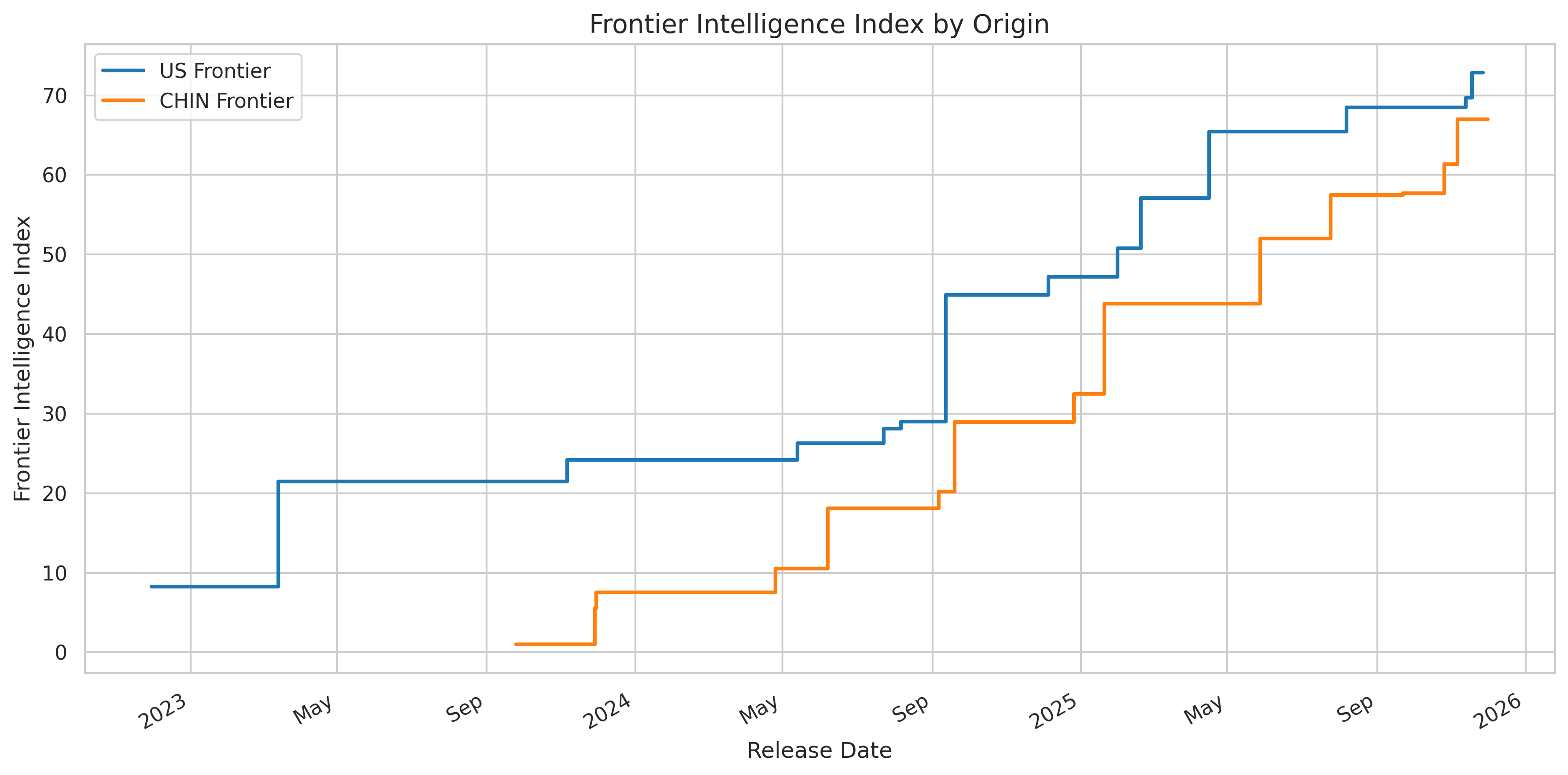
Artificial Analysis is a well respected bench-marking organization that rates how intelligence AI models are assigning them an “Intelligence Index.” The first major AI model released to get traction was the LLM that powered ChatGPT, GPT-3.5-Turbo and it took 1 year for China to release a model of similar intelligence.3 Now the frontier Chinese model is Kimi K2 Thinking which is on equal footing with OpenAI’s o3 model released 7 months prior.4 The gap is closing but China is behind.
AI+ Initative
The Chinese government and tech companies both are responding to the challenges set forth. For the governance strategy, China is focused on developing in-house talent and research to catch up to the U.S. In the AI+ initiative China is looking to “Strengthen talent cadre construction” in academics, and in industry with industry-education collaboration to drive talent growth. Also China wants to “Drive research and development (R&D) model innovation and efficiency improvement,” to catch up to the U.S.’s position. The government is doing all the right things to promote AI development in talent and promote research.
Chinese Tech Copies American Tech
Chinese tech companies do have one critical advantage. American tech companies have already created smart models. This allows Chinese companies to train their models on American AI output with nearly as high utility and knowledge. Also this has the advantage of being more efficient with compute because distilling American models short-cuts a lot of difficult and expensive compute getting your model from 0 to 1. This, however, is not a method to achieve AI supremacy; it will always keep you one step behind, as you can’t surpass another model’s abilities by just copying its abilities. Unless China can eventually start training their own models, without American crutches, it will be unable to close the gap. But, I believe that this is a good strategy to train up Chinese talent, and develop good (albeit not cutting edge) models.
Open-source Chinese AI
Also the Chinese government is pushing companies to open-sourcing their AI models. When I first heard about this I was deeply confused, it is counterintuitive that a country seeking an AI edge would open-source its hard fought research and most profits from the sale of the model. But this strategy makes sense when you recognize China is behind. China wants to do two things by open-sourcing their tech.
- Open-source pools innovation between Chinese companies reducing the mistakes repeated, and sharing new insights. This massively accelerates the catch-up process essentially merging 10 Chinese R&D departments together.
- China now dominates the open-source market for AI. You can self-host and tinker with only open-source AI models. This is important to hobbiest that want to tinker with local AI, and large corperations that want to protect trade secrets.
Data Centers - 5 to 10 years behind
Data Centers are the core of AI developments. It is critical to have vast sums of advanced computers that can train and run these models. Training these AI models requires more computation than anything else in history. Also to run these AI models after they have been trained requires lots of powerful data centers, especially considering the exponential growth in the usage of AI.
Current State
The United States has always been at the frontier of Data Center deployment with nearly 75% of the AI computing power. With over a trillion dollars in investments to make American AI datacenters it’s hard to imagine how China is going to catch up soon. But building new datacenters dosen’t just require funds, it also requires GPUs to run the AI and energy to power those machines.
China’s Energy Advantage
AI compute is extremely energy intensive, GPT-5 is estimated to use ~2 Gigawatts of power continuously, similar usage to the entire nation of Ethiopia. This makes China’s energy investments and production its greatest advantage. China has been outpacing the U.S. in energy massively with huge investments in solar, nuclear, wind, and more. 80% of solar panel production is in China, and for the past 18 years, China has ranked first in new nuclear production showing its commitment to growing a diverse energy sector. To put it plainly, from 2014 to 2024 China has nearly doubled its energy production while the U.S. only increased by 7.1%. This ability to grow energy production is critical for China to feed hungry datacenters and fuel its AI engine.
GPU Bans to China.
China is banned from importing high end GPUs that are used to train and run AI. This ban has made training competitive LLMs extremely difficult. And because China’s inhouse AI chip manufacturing is behind American and Taiwanese capabilities (as seen in the next section) they can’t just run AI models on their own chips. However, despite AI chips being banned in China does not mean they are not in China. In 3 months an estimated one billion dollars in GPUs have been smuggled into China. The best example of this is DeepSeek AI, which originally had lots of hype because it didn’t use advanced AI chips to train, but this has been debunked. This is not to say that this AI ban has been useless, it still significantly hampers the ability to buy huge amounts of AI chips.
AI Chip Manufacturing - 5 to 15 years behind
AI chips use the most advanced manufacturing processes in the world. It uses a process called lithography where machines fabricate Silicon chips by shining lasers onto a surface with curtain patterns to create circuits. Each layer is etched, deposited, and polished with nanometer-scale precision until billions of transistors are built up. Then these chips are packaged and put into electronic devices to power their computers. These Advanced EUV lithography machines can cost upwards of $150 million dollars each. A fabrication plant typically has dozens or several dozen of these machines.
Export Restrictions
The company that manufactures AI chips for NVIDIA, AMD, and Google, the leading AI chip designers, is TSMC. TSMC or Taiwan Semiconductor Manufacturing Company has 90% of global advanced chip manufacturing with the most advanced processes and capabilities. And because of U.S. restrictions, TSMC can not manufacture the most advanced chips for China. There is a bit of irony from the fact that TSMC is in Taiwan, but a big reason that Taiwan has not been invaded by China to reunite is because of its “Silicon Shield.” The idea is that if China invades Taiwan, Taiwan will self-destruct all of its manufacturing plants, hurting China so badly it will avoid this fate, or at least being so harmful to the U.S. that it will defend Taiwan to avoid this outcome.
However, the biggest disadvantage China has is their lack of ability to buy or produce advanced lithography machines. Just like TSMC is restricted from selling chips to China, ASML, the company that makes all advanced lithography machines, is barred from selling these machines to China. ASML’s CEO estimated that China is 10-15 years behind on this front.
Lagging Chinese Manufacturing
China is currently many years behind in chip manufacturing. The generations of chip manufacturing processes, in order from least to most advanced are 5nm, 3nm, and 2nm. Currently China is about to start producing 5 nanometer chips using a slower, more expensive, and more error-prone method, while TSMC has already launched mass production of 3nm, and is about to start mass production of 2nm. TSMC started mass production of 5nm over 5 years ago, so China is at least 5 years behind in terms of manufacturing.
China’s Investments
But the tides are changing. China is investing heavily into it’s chip manufacturing industry with a 50% discount to AI companies using Chinese chips. This lulls a lot of concerns with Chinese chips being less efficent, and also boosts demand for Chinese chips helping develop the industry. On top of this there is a ton of direct investment from China into the chip manufacturing industry with over $47 billion dollars in direct investment. China is being very aggressive, it knows that this is the bedrock of AI. It is also investing in the industry as a whole, promoting competition and boosting demand rather than picking a winner that eventually gets lazy and bloated.
My Thoughts
I believe that chip manufacturing capability is the area where China lags the most. Historically China has been able to just buy chips from the west, the investments into this industry weren’t as aggressive as was needed to catch up. This is also the scariest place for China to catch up. If China can manufacture the most advanced AI chips and especially the machines to make these chips then everything above in the stack, China can gain the advantage quickly.
Conclusion
Before taking the time to research and learn about China’s AI efforts, I always assumed that China was not a legitimate player in the AI space. The open-source models they release have been fun to play with and great for tinkerers, but not frontier by any means. I now understand the passion and conviction with which China approaches AI. This contrasts sharply with the U.S. talks of a government bailout for OpenAI and its hesitant and fragmented approach to AI strategy. While American discourse often gridlocks on regulation, ethics, or short-term competitive advantage, China’s approach is aggressive, comprehensive, state-backed, and relentlessly goal-oriented.
How the U.S. Will Fall Behind
The United States is riding on a lot of institutional and structural advantages. Being at the heart of the tech world and home of AI development, the U.S. can easily coast on that success. But China is doing everything possible to catch up, and that coasting cannot continue. The U.S. needs to legislate toward AI innovation, not select individual winners to bailout killing innovation and killing the capitalistic engine of competition. The U.S. is not hurt if OpenAI fails if it is able to breed 10 more frontier AI companies next in line. To keep its lead, the U.S. must invest in AI, foster more AI companies, increase public research, and invest in talent, just as China is doing.
At the current rates of innovation and change, China will win the AI wars, it is not a question of if, but when. I could see that after a U.S. AI bubble pop, during that contraction China pulls out ahead with smarter LLMs, or it could take 20 years before China develops advanced lithography machines, catches up in research, and starts developing better AI models. China is eroding the structural advantages and the U.S. is asleep at the wheel.
-
Halbwachs, On Collective Memory, 224. ↩
-
Zheng Wang, Never Forget National Humiliation, 48-49. ↩ ↩2 ↩3
-
OpenAI released GPT-3.5 Turbo in Nov. 2022 with a score of 8.7, comparable to Aliababa’s Qwen Chat 72B released in Nov. 2023 with a score of 7.6. artificialanalysis.ai ↩
-
Kimi K2 Thinking was released in Nov. 2025 with a score of 67, comparable to OpenAI’s o3 released in Apr. 2025 with a score of 65.5. artificialanalysis.ai ↩